Jim Capers
Marion's Merry Men
Drum Major and Revolutionary War Veteran
Jim Capers was born on September 23, 1742, in Christ Church Parish, South Carolina. He was a free man of color who served bravely in the American Revolutionary War. He joined the military around June 1775 as a drum major in the 4th South Carolina Regiment and later served under the famous General Francis Marion, also known as the “Swamp Fox.”
During the war, Jim Capers fought in several important battles, including the Battle of Savannah, Eutaw Springs, Port Royal, Camden, and Charleston. At Eutaw Springs, he was badly wounded — receiving four injuries, including cuts to the face and head and a gunshot wound to his side. A fellow drummer behind him was killed in that same battle.
Jim continued serving until October 1, 1782, spending more than seven years in the army. After the war, he was present at the surrender of British forces at Yorktown, Virginia, in 1781. He later traveled to Philadelphia and eventually returned to Charleston, where he was discharged.
Years later, in 1849, at the age of 107, Jim applied for a military pension in Pike County, Alabama. His service was confirmed by other veterans who remembered him as “the great drummer” under General Marion. In 1852, Congress approved a special act granting him a pension.
Jim Capers died on April 1, 1852, at the age of 109. He had a wife, Milly Capers, and several children: Harriet, Eliza, Jim, Jenny, another Harriet, and Charles. Unfortunately, Milly’s request for a widow’s pension was denied because she was enslaved at the time, and the law did not recognize their marriage or allow enslaved people to receive pensions.
In 2015, Jim Capers was honored by the Alabama Sons of the American Revolution for his service.
With every beat of the drum came the sound of freedom.
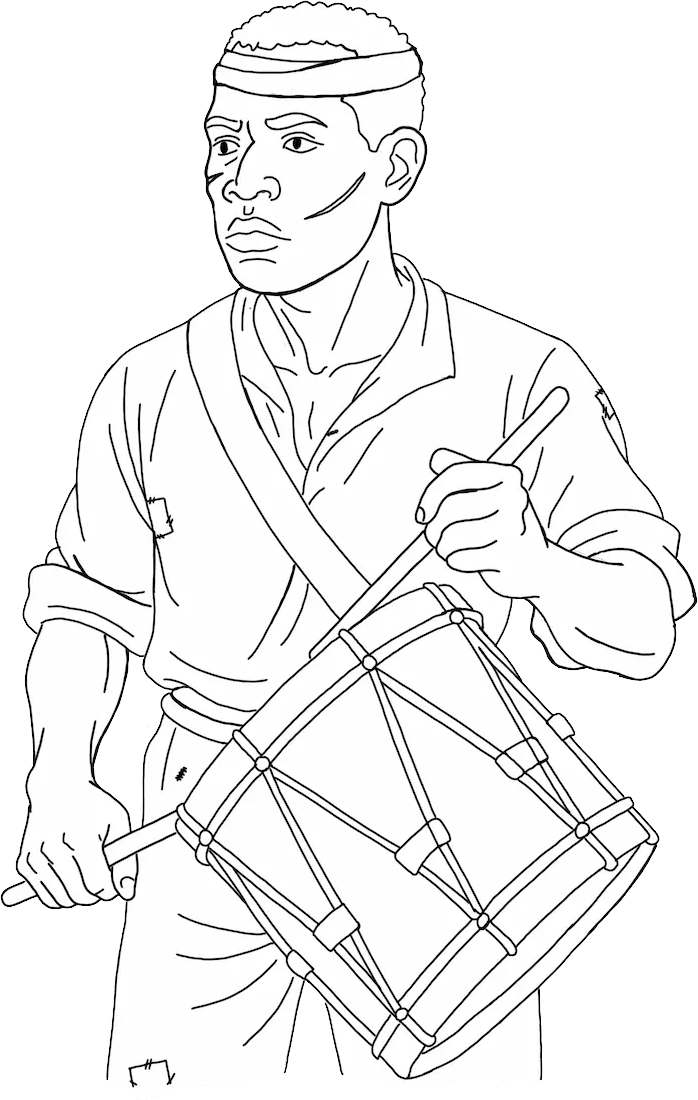
Description of Jim Capers
Jim Capers was likely in his late twenties to early thirties during his service as a drummer with the forces of Francis Marion. A man of African descent, he likely had a darker complexion, though specific details of his origins remain uncertain. Historical accounts record that he sustained multiple wounds at the Battle of Eutaw Springs, including a head injury from a sword, two facial cuts, and a musket ball wound that passed through his left side. These injuries reflect the significant dangers faced by those serving even in non-combat roles. As a drummer, he may have worn elements of a military uniform, though it is also possible he wore simpler, utilitarian clothing common to enslaved laborers in camp settings—such as a rough shirt, trousers, and well-worn shoes. This depiction should present him with appropriate historical dignity, reflecting both his role and the hardships he endured in service.