Joseph Willis
Marion's Merry Men
Revolutionary War Soldier
Joseph Willis was a Revolutionary War soldier, preacher, and early church leader whose life showed great determination and courage. He was born in 1764 in North Carolina into slavery. His mother was Cherokee, and his father was a wealthy English plantation owner. Although his father tried to free him in 1776, Joseph did not gain his full freedom until 1787, when the North Carolina government officially granted it.
During the American Revolution, Willis served as a soldier under General Francis Marion, known as the “Swamp Fox.” From 1780 to 1782, he fought in Marion’s militia, which used quick and clever fighting tactics against the British. Willis was proud of his service and later said he was one of “Marion’s men.”
After the war, Willis became a preacher and helped spread Christianity to new areas. He moved to Louisiana, even though it was dangerous for Protestant ministers to preach there at the time. Despite facing threats and discrimination because of his race, he continued his work. In 1812, he helped start Calvary Baptist Church, and he later founded many more churches. In 1818, he also helped create the Louisiana Baptist Association.
Joseph Willis died on September 14, 1854. His life is important because it shows how someone born into slavery could overcome great challenges to serve his country, practice his faith, and become a leader in his community.
His story crossed cultures, identities, and borders.
Description of Joseph Willis
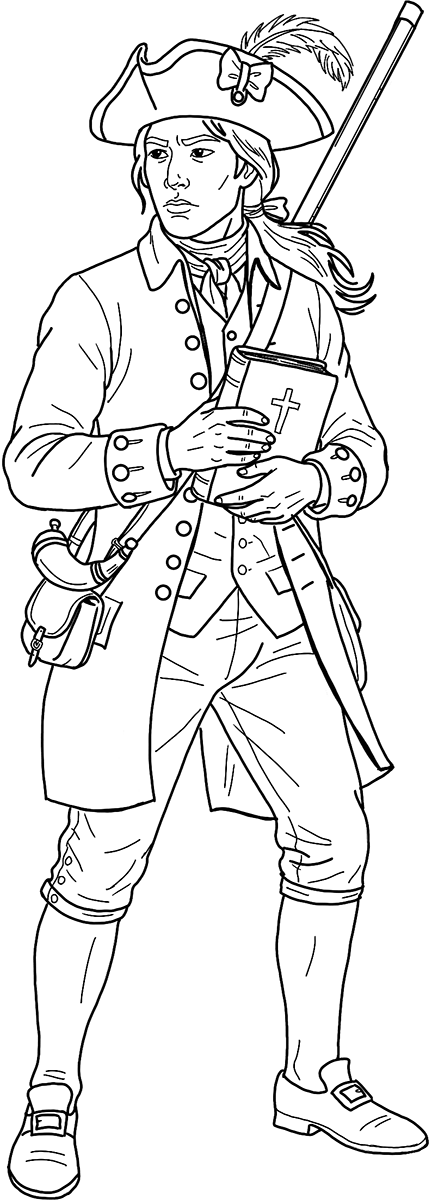
Joseph Willis was a young man in his early twenties during his service under Francis Marion. Of mixed European and Cherokee ancestry, he was born into slavery before later securing his freedom. He likely wore his hair long and dark, with features that may have included almond-shaped eyes, a narrow nose, and thinner lips. His build would have been youthful and physically fit, consistent with the demands of military service. During his time with the militia, Willis would have worn standard clothing such as a hunting shirt, breeches, and sturdy shoes. In some depictions, he may be shown with a coat and a tricorn hat adorned with a feather, suggesting a comparatively well-outfitted appearance that could reflect his later status as a free man. In this portrayal, he is shown holding a Bible—an intentional reference to his life after the war, when he became a preacher and founder of a church community.